Three travel sketchbooks and four small paintings from memory, José Ramón Sierra
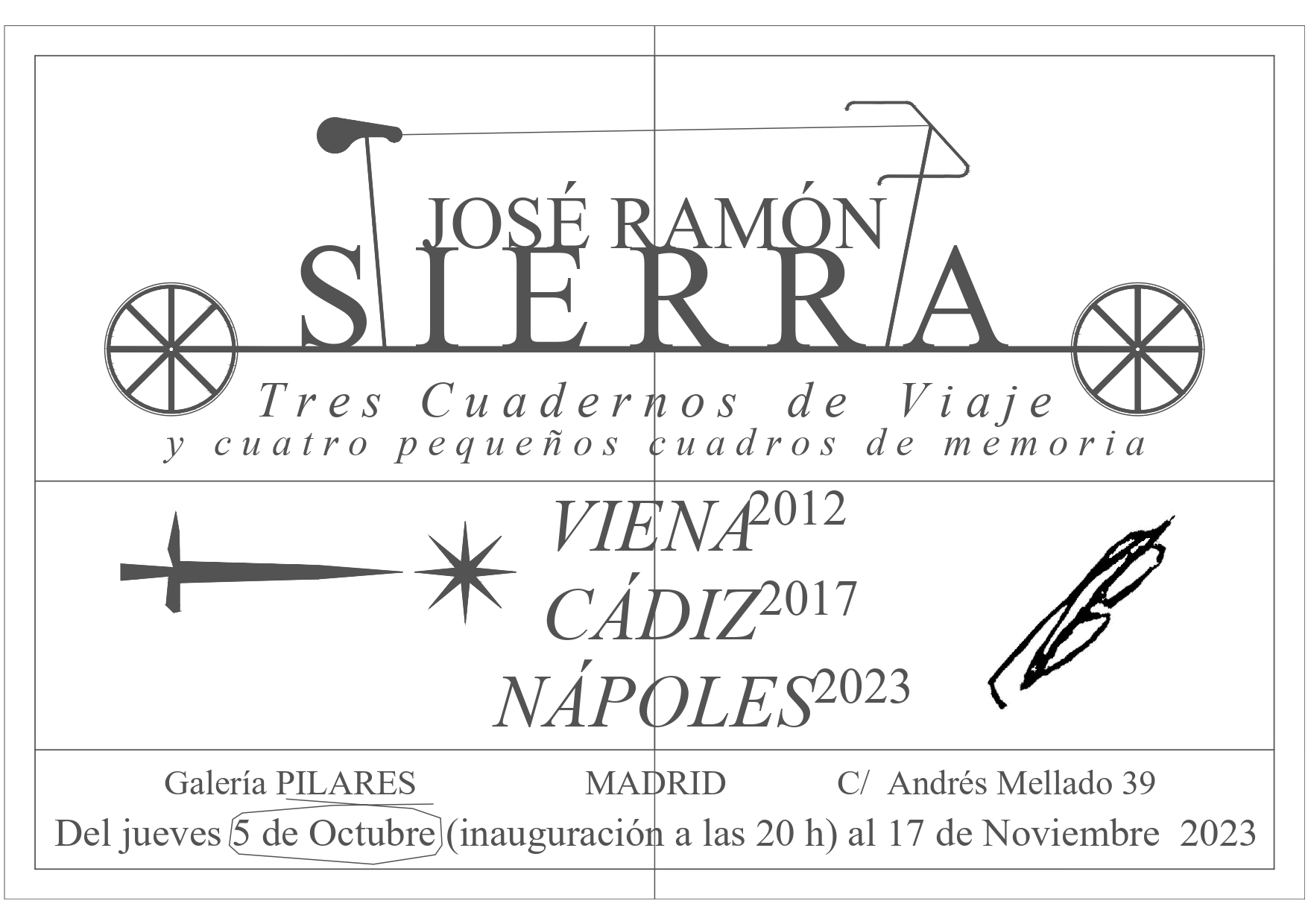
EXHIBITION BY JOSÉ RAMÓN SIERRA, 5 OCTOBER TO 17 NOVEMBER 2023
VIENNA 2012
Travel sketchbook
Notes and sketches
These travel drawings are not a guide, nor are they posters meant as bait. They are an invitation to lose oneself in the emotional labyrinths of the journey, which demands of the traveller only two essential pieces of spiritual luggage: the sensitivity to be wounded and the intelligence to feed on the wound.
They are notes from life and sketches, two essential and distinct ways of drawing, of living the artistic experience. José Ramón Sierra has repeatedly explained, in academic texts related to his teaching, how he understands the difference between the two: while the note from life is primarily a practice of knowledge, the sketch is one of invention. Since such knowledge cannot be univocal or scientific but a creative version of what is seen, and since the sketch is the most personal of creative essays, both can come together as the expression of active thought, permanently awake. The pages offered here are always both things at once.
They present impressions that have served as the foundations of proposals: visions and understandings with which to shape other realities, other paths of development with unforeseen, open and difficult endings. Almost always they show us crossroads, pauses to look around. Crossed glances, contaminated feelings. Transversal versions in which time seems to dissolve momentarily to offer fruitful observations, and in which images, painterly gestures and even titles become factors of communication.
The prominent presence of Fischer von Erlach is striking, through the deconstructed Karlskirche, which recalls the plague together with the dynastic claim to the Spanish throne in Miracle of Hercules, and through the celestial, planetary vision of the Library in Planetarium. In Siege and Look at Me, Vermeer’s model appears enclosed behind a wall built from the blocks of Wagner’s Postal Savings Bank, whose gate is cut out with the scissors of the original Knize shop beneath cut-outs of the jacket of Vermeer’s painter seen from behind, in Klassizismus. The classical column is a far-reaching counterpoint in American Bar. In Nun, the carnality of Rubens’s Helena from the Viennese museum appears mortified by the hair shirt of the cloistered Counter-Reformation, while in Heritage and Crime, so reminiscent of Loos, it reappears in connection with Ed Ruscha’s memorable exhibition in the same museum, over a fragment of an Arcimboldo used by the American artist to illustrate the unsettling relationship between nature and artifice, a recurring theme in this sketchbook too, as in Mirrors in the Park, where Olbrich’s golden leaves spring from Gottfried Semper’s facing, symmetrical museums.
And curiously, nothing of Vienna’s famous Velázquez paintings, before which, I know, the author paused attentively for a while. Dear J. R. Sierra, I hope to see you back here soon, with your sharp scissors.
Claire Loos-Breunig
Vienna, 2013