Tribute to the women geniuses, Manuel Terán
WOMEN OF ART IN HIS EYES
“Laughter made us invincible. Not like those who always win, but like those who never give up.” (Frida Kahlo)
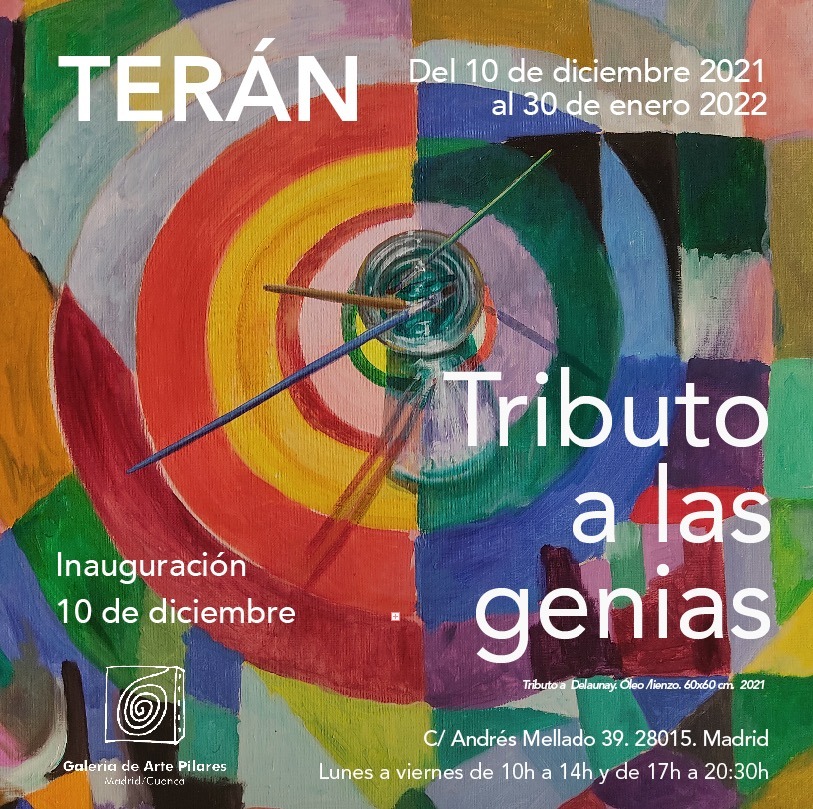
It is pleasing and commendable that a male painter should take the trouble to underline in his work the importance of women in art, presenting a generous roll of them: women painters from different periods and styles. The exhibition is entitled “Tributo a las Genias”. The word “genia”, the feminine of “genio” (genius), is not in the dictionary of the Royal Spanish Academy, but perhaps those who seek to feminise the language will manage to introduce it. Semantics is certainly not naïve or harmless; quite the contrary. The title speaks of tribute and not of homage, which is more usual and more pompous. According to the Academy’s dictionary, “tribute” means an “obligation imposed for the use or enjoyment of something”. It is a form of recognition, of the painter’s homage for the enjoyment of these women’s artistic work.
The painter’s attitude runs counter to the gibe repeated even on the Internet, taken from Simone de Beauvoir’s ironic remark, and thus in the opposite sense: there are women who are mad and women of talent, but none has that madness of talent called genius. A contemptible assertion.
Terán is telling us that he feels indebted to the pictorial work of these women, masters of art, just as he feels bound to the male artists to whom he previously devoted another exhibition, “Tributo a los Genios”, held at the Antonio Saura Foundation, Casa Zavala in Cuenca, in this same year, 2021. We should not forget that any self-respecting artist has roots in the tradition that goes back to the caves of Altamira or Lascaux, for all good art is based on first discovering the great masters —men and women, if we follow inclusive language—; otherwise one would be a naïve artist. “Where there is no tradition, there is plagiarism,” as the admired scholar and art critic Eugenio d’Ors put it, with forcefulness and wit.
I sense that after the exhibition “Tributo a los Genios” —in which only one woman appeared, the Japanese artist Kusama, among great names and confessed masters of the Chilean artist such as Picasso, Rothko, Banksy, Basquiat, Dubuffet, Fontana, Freud, Indiana, Johns, Magritte, Matta, Pollock or Vermeer— Terán perhaps felt in debt to women, to the women artists the world has known, who in many cases were passed over by the simple dynamics of a male-dominated society, which even came, directly or indirectly, to coin the idea that art made by women was inferior or second-rate. That was not and is not so, if we pay the slightest attention to art made by women over the centuries, even though it sometimes had to take refuge behind male pseudonyms.
Let us remember, for example, how Great Britain, a country rich in watercolour painters, today recognises in antique shops and flea markets the beautiful watercolours that many women painted in the intimacy and privacy of their living rooms while running the house and looking after their children. They lacked “a room of one’s own”, as Virginia Woolf put it. Some signed their work and others did not; most did not dare to exhibit, because men would not allow it or because the society they lived in was not favourable. Their artistic work remained, signed or unsigned, but with a clear artistic vocation and unquestionable aesthetic value. Virginia Woolf also coined it: behind many anonymous works there is a woman’s name.
Terán’s paintings show the faces or the personal or pictorial attributes of Georgia O’Keeffe, Frida Kahlo, Tamara de Lempicka, María Blanchard, Ángeles Santos, Yayoi Kusama, Mary Cassatt, Louise Bourgeois, Hilma af Klint, Sonia Delaunay, Maruja Mallo, Remedios Varo… The roll could hardly be more distinguished and select, each of these women with her own singular characteristics. It should be borne in mind that the author has not focused on them just because, but because their valuable, radiant and singular work has earned his artistic attention, his painter’s eye.
I do not intend to translate Terán’s appreciation of these women artists literally, but there they are: Georgia O’Keeffe, for her spectacular change of scale, above all in her flowers; Frida Kahlo, for her particular iconography of illness and pain; Tamara de Lempicka, for her beautiful Art Deco and modernist language; the stooping María Blanchard —“la petite Marie”, as Picasso and other avant-garde artists called her— for the special tenderness of her Cubism; Ángeles Santos, painter and graphic artist, for her particular drawing and language of the forties and fifties, with surrealist accents in her first paintings; Mary Cassatt, a maternal interpreter of Impressionism; Maruja Mallo, of the Generation of ’27, with her singular extravagances; Yayoi Kusama, for her colourful world of dots and spots; Remedios Varo, for her magical, dreamlike world; Sonia Delaunay, for her radiant, chromatic Orphism; Louise Bourgeois, for the power of her sculpture, with her towering spiders, daughters of Dalí’s dream elephants; Hilma af Klint, a surprising Swede with her abstract art of great ornamental beauty; Maria Helena Vieira da Silva, for her elegance and refinement in abstraction; and the surprising Chilean Violeta Parra, better known as a singer, who also painted and exhibited her artistic work, now in her museum in Santiago: a painting somewhere between naïve and acid expressionism…
… And so we could go on, one by one, through the artists in the thirty or so paintings that Terán is presenting at the Ateneo de Madrid and will later show, as a touring exhibition, in other venues.
Women artists, women painters, most of them of the present of several centuries, if that paradox may be allowed as an apparent contradiction. Art that endures becomes classical, universal. In art there is no evolution, as in science, but metamorphosis, as the Swiss master architect Alberto Sartoris liked to repeat. Who would dare to say that Picasso is superior to Velázquez because he was born later? It is not possible; between the art of the one and the other there has only been metamorphosis in form, in aesthetics, in materials…, but the art of both is classical, in the sense of permanent and universal, valid for all times and for all men and women, above all those of art.
The same is true of the women painters chosen by Terán. What has happened between his first exhibition on male geniuses and the current one on women geniuses? Without doubt an attentive gaze, a fair balance, a necessary parity, led in this case by a male artist. The two catalogues, “Tributo a los Genios” and “Tributo a las Genias”, are today an undoubted work of reference: geniuses with a capital G, as their works deserve, and through those works we know them all.
And not only that. On this occasion Terán wanted the catalogue texts to be written by women, so that we could set out our own reflections here from the same sphere as the men with whom we share the world, life and existence.
A distinguished lineage
Let it be said first that Terán is today one of the most sought-after realist painters on the art circuit. His mastery of drawing and colour and his good taste make him much in demand as a portraitist. The visual artist belongs to the fertile lineage of Chilean painters settled in Spain, headed by the great Claudio Bravo, whom I had the honour of meeting, knowing and admiring. I recently published a portrait of that artist in my book “Historias y personajes del Norte de África II” (1). That “Chilean” realism of great mastery is evident in the portraits of women painters now presented by Terán, in which each, as tradition dictates, is shown with her face or with her defining attribute, whether a rose or an object —a tradition that goes back to the classical Greco-Roman world. Every god, goddess, hero or nymph has a defining attribute in their iconography, and the same happens with the Christian saints.
The series of both male and female geniuses constitute, in any case, a fine array of portraits, a genre sometimes disparaged in the past as the “genre that fed artists” in painting. These are not commissions, but a free acknowledgement of the masters, male and female, who preceded the artist. It has been said that Spanish painting could not be properly understood without the portrait, and that the Prado Museum is its summit, beginning with Velázquez’s Las Meninas. The portrait is the liveliest and most unsettling of living natures: the human figure, the face, challenges us with its gaze. In Terán’s portraits of women painters they appear firm and self-assured, confident in their art, which is or was their way of being and remaining in the world. The National Portrait Gallery in London devotes its entire building to the portrait as the genre par excellence, in every imaginable medium. In the United Kingdom the portrait is so important that any export of a portrait is scrutinised closely, because it requires an export licence; it is considered that no portrait of interest to the country’s history should leave it.
The “genias”, the visual artists selected by Terán, have enjoyed social and critical recognition of their artistic work. They have entered museums and/or major art collections, and cannot complain, as did the feminist collective the Guerrilla Girls, who in the eighties made lightning raids on the Metropolitan Museum with guerrilla tactics and their famous cry and slogan: “Do women have to be naked to get into the Met. Museum? Less than 5% of the artists in the Modern Art sections are women, but 85% of the nudes are female.” With that tactic of rapid invasion by hooded women wearing gorilla masks, they sought to denounce discrimination against women in art. And they took their action not only to the visual arts but also to literature and theatre. The posters, flyers and writings of the hooded Guerrilla Girls have been exhibited at MoMA in New York and many other museums. Without protest there is no presence. American feminists know a lot about this and are efficient in putting it into practice. They followed to the letter the words of the French writer Simone de Beauvoir: “Feminism is a way of living individually and of fighting collectively.” (I wish to state that my feminism is a defence of human rights on an equal footing with men, far removed from the radical feminism of reversing the burden of proof or systematic parity, among other excesses.) Emma Watson put it boldly: “Women feel as if they need approval to do things. We must lead, take the reins and change that.” Or Margaret Atwood’s advice: “If we want a fairer world, we have to stand up for a fairer world for everyone.” And Camilla Läckberg rounded it off: “One of the reasons men have power is that they are much better than we are at forming fellowships.” Conclusion: we need to wake up in this area, in groups and associations.
The famous National Museum of Women in the Arts (NMWA), founded in Washington in 1981 by the collector Wilhelmina Holladay, was a 20th-century milestone in this vindication of women devoted to art. Its declared aim was to recognise “the achievements of women in the visual, performing and literary arts”. Wilhelmina and her husband Wallace realised that the great museums lacked women’s names and decided to create one precisely to highlight them and their signatures. Wilhelmina used to say that women’s art was as hidden in museums as that of Native Americans. Her “road to Damascus”, her realisation of that silence, came when she saw a painting by Clara Peeters (1580–1621) in museums such as the Kunsthistorisches Museum in Vienna or the Prado in Madrid: an excellent painter who nevertheless did not appear in art history manuals on a par with her male colleagues of Flemish painting, nor in textbooks. Something was wrong.
It is not that women artists want a ghetto for their work, but the Washington museum was a great wake-up call in favour of their presence in museums and in history.
Gradually, museums and public collections bearing women’s names have appeared, which is very satisfying because it re-establishes a parallel with museums and collections bearing men’s names. Let us mention some of the few examples of women artists, such as Maria Helena Vieira da Silva, Graça Morais or Paula Rego in Portugal. In Spain there are the museums of the painter Mayte Spínola in Marmolejo (Jaén) and of Baroness Carmen Thyssen-Bornemisza, as a collector, in Málaga, Madrid and Andorra. Violeta Parra, also a visual artist, has a large museum in Santiago de Chile covering all her work. Joan Miró had the kindness to put the name of his wife, Pilar Juncosa, beside his own on the Foundation and museum in Majorca, for we cannot forget the saying that behind every great man there is a great woman who supports and strengthens him. Cherchez la femme, as the French say.
Women artists of the past benefit from a revival before the public from time to time, and Terán has given them one with this exhibition, “Tributo a las Genias”, which makes them resonate again in the present and visible in the immediacy of an exhibition that reminds us that art is at once aesthetics and thought, beauty and communication, following the assertion that images aspire to the same rights as language.
We must know and acknowledge that today museum institutions, at least public ones, pay more attention to art made by women. They set aside dates such as the month of March for them, or pay closer attention to the proportions of exhibitions or acquisitions, in order to balance the presence of men and women artists. It is curious how this new attitude provokes renewed misogyny in certain men. A pity! As I have said, I do not like systematic parity, but we must ask ourselves, when the numbers are far from it, why women artists do not occupy a space similar to that of men —or vice versa, if the opposite were the case. The American essayist Siri Hustvedt described this situation clearly: “I think it is urgent to come to terms with ongoing misogyny and how it interacts with questions of class, sex and colour.” Culture, literature and art in general can be a key element, since they do not exist outside philosophy or the history of ideas.
Conclusion
What lies behind this exhibition by Terán? A desire to highlight the woman as creator and creative force, the women who left evident mastery in the History of Art, which nourishes like an umbilical cord all the artists who came after them. An exhibition that highlights the diversity of names, styles and origins and thus shows that women’s artistic intelligence knows no borders.
With his beautiful, forceful portraits and allusions to their painting, Terán has given women artists recognition, resonance and a renewed presence that will endure. There has been no request, claim or demand behind this female presence in images, but the firm will of a painter who wishes to underline the importance of the women artists who left their mark on the History of Art, a teaching and an aesthetic from which everyone drinks and which we all continue to enjoy.
Julia Sáez-Angulo
International Association of Art Critics
Notes
1. Sáez-Angulo, Julia: Historias y personajes del Norte de África; Editorial Espacio Cultura, A Coruña, 2021.
2. Guerrilla Girls. The Guerrilla Girls’ Bedside Companion to the History of Western Art. London: Penguin, 1998.