Tribute to the geniuses, Manuel Terán
AN ART FOR THE END OF ART. REFLECTIONS ON TERÁN’S PAINTING
Fernando Castro Borrego
When in 1997 Arthur Danto formulated his famous theory of art after the end of art —itself a development of what Hegel had briefly anticipated on the subject in the 19th century— critics thought that new possibilities for producing art would open up while others would close. In any case, “after the end of art” would mean accepting, in Danto’s view, that painting as we had known it had come to an end. The aesthetic category of the new would become a manifestation of art as concept. Andy Warhol, one of the artists Danto took as a reference, began to be seen as an artist akin to the conceptual tendency, even though he was a painter. He painted icons whose only reference was the signs of consumer society and mass culture. The creative subject, Andy Warhol in this case, voluntarily disappeared behind his icons.
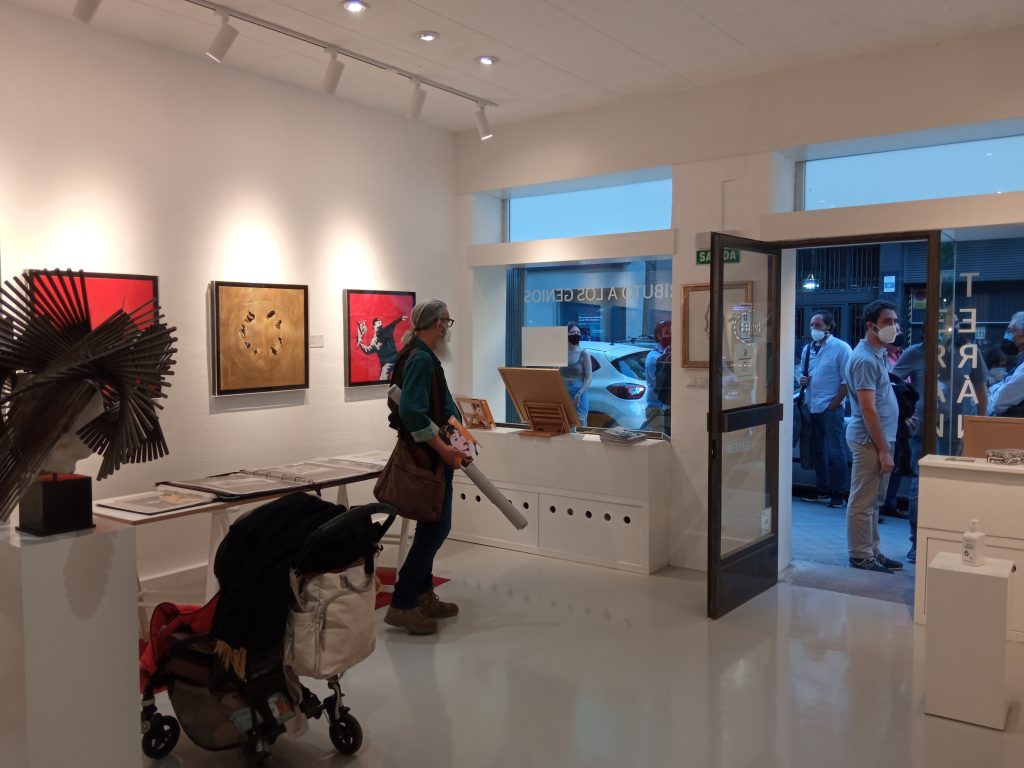
In his series Tribute to the Geniuses Terán proposes something else: the return of painting as a symbolic strategy. Unlike Warhol, Terán is a painter’s painter who neither disappears behind his work nor maintains a cold, indifferent attitude towards it, but shares with Leonardo da Vinci the unshakeable belief that everything fits within the universe of painting, which is itself a universe. His tributes take the form of pastiches, but they are not pastiches. Love, not irony, moves his brush. The artists he chooses to pay tribute to are ones he admires (Francis Bacon, Banksy, Marc Chagall, Jean Dubuffet, Lucio Fontana, Francisco de Goya, Lucian Freud, Keith Haring, David Hockney, Robert Indiana, Jasper Johns, Yves Klein, Kusama-Velázquez, Roy Lichtenstein, René Magritte, Roberto Matta, Joan Miró, Pablo Picasso, Jackson Pollock, Joaquín Sorolla and Andy Warhol). The list could hardly be more heterogeneous, and it follows no order. He pays homage to the artists he admires, even when his own work bears no relation to theirs. The heterogeneity of his preferences is evident and proves E. Gombrich right: there is no art, only artists. This thoroughgoing nominalism leads him to skip over aesthetic categories and chronologies. The only thing the recipients of his tributes have in common is that they belong to 20th-century art, although he does not strictly respect that chronological framework either. Another singular tribute is the one he pays to Shunga, the Japanese erotic art that became popular in a period stretching from the 18th century to the early 20th. Terán does not work with the category of the original but with that of the copy, although what he does is not, strictly speaking, a copy. His work echoes a tendency known as appropriationism, which developed in the postmodern period during the eighties and nineties of the 20th century, led by the critic Douglas Crimp and the photographer Sherrie Levine. The very name denotes the ironic bias of such creations, which questioned the idea of authorship and authenticity. The point was to make works from images belonging to other artists. Paradoxically, what these postmodern artists advocated was the renunciation of originality. There was no interiority or metaphysics in their works, and we will not find these aesthetic categories in Terán’s tributes either. However, in Terán the denial of the inner world is not formulated as an ironic or conceptual device. The very idea of tribute implies admiration and love, as we said. Nor do narcissistic or self-expressive traits emerge in his work. What can be seen in it is a powerful anti-naturalism of unmistakably modern roots. It is no coincidence that before this series he painted urban landscapes. It used to be said that art imitated nature; then, that nature imitated art (Oscar Wilde). But what Terán proposes is another form of mimesis: the artist imitates the artist. Not in the medieval manner, as exemplum, but by establishing a distance from the object of representation, which allows him to keep control over the creative act and prevents mere likeness from becoming the axis of his aesthetic proposal.
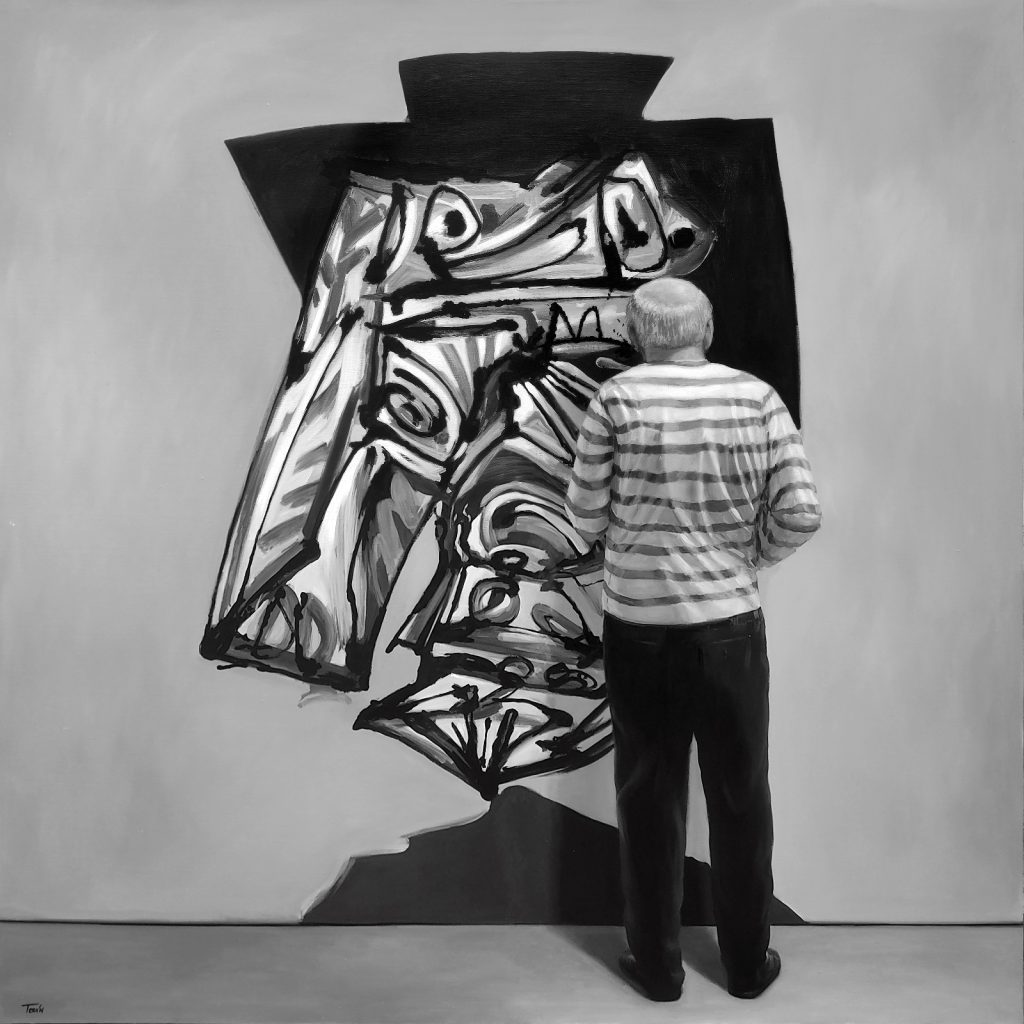
Terán dialogues with some artists of the past as if their works were landscapes. I mean that the artist’s attitude in paying these tributes is analogous to that of the landscape painter who sets up his easel before nature. But the difference between Terán’s approach and a landscape painter’s is that the latter, in copying nature, can modify it but not criticise it. Images of landscape can be modified but not criticised; we criticise human beings and their works, not nature. I should make clear that when I use the word criticism I exclude any satirical connotation. The critical function implies knowledge, and in art, as we know, what is given to be seen (donner à voir, as Paul Éluard said), if inspired by love or admiration, cannot take the form of rational knowledge, but only intuitive knowledge. In this respect I refer to a maxim of Charles Baudelaire: the best criticism of a painting is a poem. Terán, for his part, maintains that the best criticism of a painting is another painting. That is precisely where his originality lies. In this exercise of criticism Terán always introduces a personal note, but a very discreet and subtle one. The ways in which he pays tribute to the art of the past reveal, as I say, great subtlety, something that may go unnoticed by the viewer. The secret lies in the details the artist introduces into the composition, which work like clues or instructions for use telling us what his tributes mean. Let me give some examples. Look at his re-reading of Goya’s half-buried dog. There is an enigmatic detail in this tribute: the bunch of keys alluding to the Quinta del Sordo. Terán is telling us that the dog is none other than Goya himself, since the keys are those of his house. By associating the image of the trapped dog with the keys to his house, he suggests that the sorrows human beings suffer may have to do with the fact that they know where the keys are that could open the house-prison they have built for themselves. They know, but they cannot reach them. That is how the dog anxiously gazes at the keys that could free it. It is an allegory of impotence. In the tribute to Picasso, he depicts a painting made “in the manner” of that artist in a strange location: hanging at the end of a narrow corridor in an ordinary block of flats. On another occasion we see the author of Guernica from behind, absorbed in contemplating a work by Antonio Saura, Portrait of Dora Maar, a version of Picasso’s own painting of the same title. The game is subtle, because Picasso is obviously not looking at the portrait he himself made of Dora Maar, his companion at the time, whose tears are the real subject of the work, but at the “tribute” that Antonio Saura, a confessed admirer of Picasso, paid to that portrait. It is therefore a tribute to a tribute: Saura pays tribute to Picasso, Picasso recognises it as such and, looking at the Aragonese painter’s work, probably compares Saura’s portrait with his own. Picasso, the great creator, is now the spectator of a work painted as a tribute to his own. Perhaps he then thought of Dora Maar and the reason for her tears. Finally, Terán, taking on the role of witness or notary, attends this encounter and thus pays homage to both creators. In fact, the origin of this hermeneutic approach lies in Velázquez’s Las Meninas (see Foucault’s brilliant study), whose subject is none other than the relationship between the act of painting and the act of looking. When he depicts Lucian Freud, caught in the act of contemplating an image of old shoes in his studio, he evokes Van Gogh, for whom, as we know, old shoes are a brilliant ellipsis. Terán is telling us that there is a relationship between the two artists.
Terán’s work is at once referential and self-referential. The secret lies, as we have said, in the details. Terán is a great composer. Perhaps this explains the tribute he pays to Shunga, the Japanese erotic art already mentioned. The artists of that school cultivated ellipsis and a subtle play between the explicit and the implicit. Such refinement was unknown in Western art, which is why this painting made such an impact on the French Impressionists and Symbolists when it became known at the end of the 19th century. The details require a complicity from the viewer that is not always easy to achieve. The simplest thing is to say that these paintings are merely copies of works by painters he admires. Velázquez also knew that the art of painting is difficult, as is the act of interpreting it. Long before, Plato had said that “beauty is difficult”.
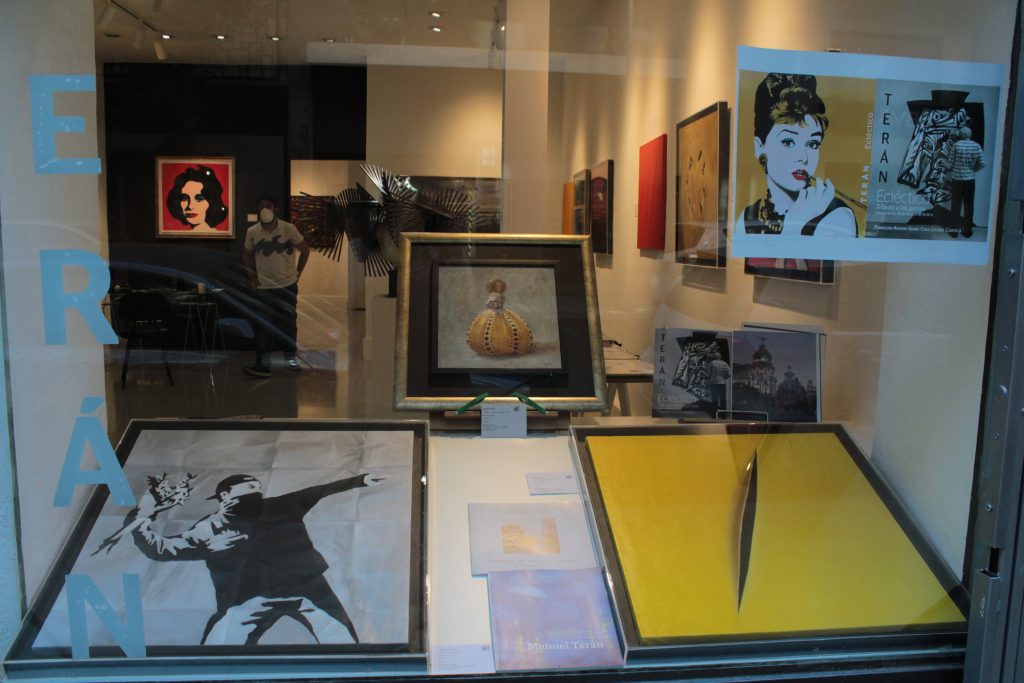
In short, Terán’s approach implies an absolute faith in painting as a symbolic art. To speak about another artist’s work, the painter does not need the mediation of words; it is enough to make a replica of one of their works. It seems easy, but that ease is deceptive. Look at the relationship he establishes between Kusama’s pumpkins and Velázquez’s Las Meninas. From a formal analogy between a pumpkin painted by the Japanese artist and the wide skirt of one of Velázquez’s infantas, the spark of beauty flies. This game evokes at the same time a prodigious and unusual metamorphosis. Analogy is one of the keys of the symbolic art of painting. We might ask how a creative act can arise from an image that is already rich and eloquent enough in itself. Let us look at another example. When he tackles the work of Lucio Fontana, he “turns around” the meaning of his famous cuts in the canvas and transforms them into painted shadows. Thanks to this inversion, the result is not a Fontana but a Fontana painted by Terán, just as a field of poppies painted by Monet is not a copy of the field but a creative act proclaiming the omnipotence of Monet’s gaze. His versions of Fontana reveal what we might call “the omnipotence of painting”. Fontana’s most significant gesture consisted in slashing the surface of the painting; well, Terán says the opposite: if that slit creates a shadowy void, why not paint that shadow? In other words, why not suggest that the cut made in the canvas existed, or exists, and can therefore be evoked symbolically, as a shadow? Everything is in painting; everything can be said through painting. From this question another arises: why is a real cut better than a painted one? Underlying this is the familiar charge levelled by avant-garde aesthetics against the aesthetics of Impressionism and naturalism, according to which nothing was more reprehensible than illusionism in art. Lucio Fontana chose the image of the slashed canvas. He was not wrong, but repeating that gesture ad nauseam would have been a blunder. We can see how far the shadow of Platonic epistemology reaches: a painted chair is a substitute, which is why Plato held that painting is inferior to craftsmanship, since the craftsman gives us the original, the chair itself, while the artist merely produces a deception, an illusion, a lie. Why is the image of a slashed canvas more truthful than one that suggests the existence of the slash through a shadow? Terán does not seek to challenge Fontana’s linguistic discovery but to dialogue with it, and that dialogue takes the form of a game.
I will close this essay by returning to its opening reference: Arthur Danto’s idea of the end of art. In the preface to his book he gives the following example to define what art we may expect after the end of art. It is a work by the painter David Reed, entitled #328, from 1990, which he chose for the cover of his book. It is Reed’s tribute to Hitchcock’s film Vertigo, from 1958. Reed admired the film so much that he altered one of its frames, turning it into a painting from which he made an installation reproducing the bedroom in which one of the film’s sequences takes place. In that installation, the altered frame from Hitchcock’s film was shown on a cheap television set, like those found in hotels at the time. It was Reed’s tribute to Hitchcock, and that is how the altered image was first shown, in a retrospective of Reed’s work at the Kölnischer Kunstverein in Cologne. Terán does something analogous, but by transposing not an original film image into the space of an installation, but one painting into another. The differences between Terán’s approach and Reed’s symbolic strategy, and also Danto’s philosophical gloss on it, are evident. But while Danto approved of Reed’s appropriationist version, he would surely not have accepted Terán’s approach, for in that preface he concluded as follows: “To glorify the art of previous periods, however glorious they may have been, is to wish for an illusion like that of the philosophical nature of art.” Well, Terán glorifies the art of the past. And why shouldn’t he?, I ask. As a prophet of postmodernity, Danto mocks the determinism of the avant-garde in that preface, questioning Clement Greenberg’s formalist theses, while displaying the same dogmatic attitude himself by decreeing that the art of the past may in no way be “glorified”. I can only describe this argument as a philosophical prejudice on the author’s part. One need neither regret nor be ashamed of a confessed love of history and its glories. Moreover, looking at Terán’s Tributes, no one can think that he advocates a return to the past just because he expresses his admiration for artists whom he dares, without the slightest complex, to call “geniuses”. They are not mere copies, since they are made with his own technique and introduce variations by virtue of which the original is modified, that modification being a creative act in itself. We all know that the glorious past will not return, but I see no reason to refuse to pay tribute to those artists whose genius transcends the historical moment in which they happened to live. As Baudelaire said: every work of art has an eternal side and a transitory or historical one.